Dynamic Odds Calculation: How Algorithms Adapt During Live Football and Horse Racing Events
Written by Klara Hoffmann · Aug 24, 2026
Dynamic Odds Calculation: How Algorithms Adapt During Live Football and Horse Racing Events
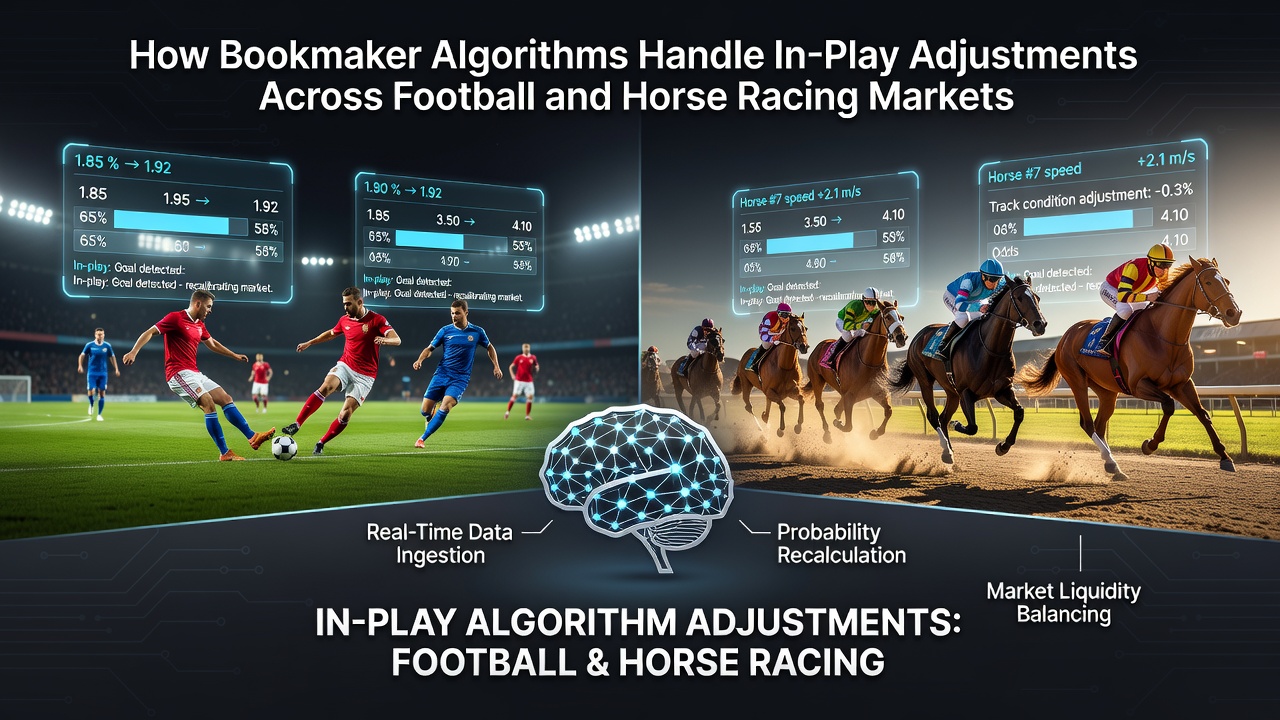
Bookmaker systems rely on layered computational models that process continuous data streams during live events, and these frameworks recalibrate probabilities as new information arrives in football matches and horse races alike. Real-time inputs such as player positions, ball movement, and injury reports feed directly into the engines that set and revise odds, while horse racing platforms track pace, positioning, and track conditions through sensor networks and video analysis. The result is a constant flow of price changes that reflect shifting probabilities rather than static pre-event assessments.
Core Data Inputs Driving Live Adjustments
Football algorithms ingest multiple synchronized feeds including GPS tracking from players, official match statistics, and external sources such as weather sensors, and these elements combine to trigger immediate recalibrations when a goal occurs or a key substitution takes place. Horse racing systems meanwhile monitor split times, stride analysis, and sectional data collected at fixed intervals along the course, which allows models to update win probabilities for each runner as the field progresses through successive stages of the race. Observers note that both sports depend on low-latency connections to ensure the adjustments occur within fractions of a second of the triggering event.
Model Architectures and Update Mechanisms
Machine learning components form the backbone of these platforms, where historical match and race datasets train predictive layers that then receive live overrides from current conditions. In football, Bayesian updating techniques revise goal-scoring expectations after each attacking sequence, while Poisson distribution variants recalculate expected totals when possession statistics shift dramatically. Horse racing models often employ survival analysis frameworks that treat each horse's finishing time as a variable distribution, and they adjust those distributions when pace figures deviate from projected benchmarks. Both approaches incorporate regularization methods to prevent overreaction to single anomalous data points.
Market-Specific Response Patterns
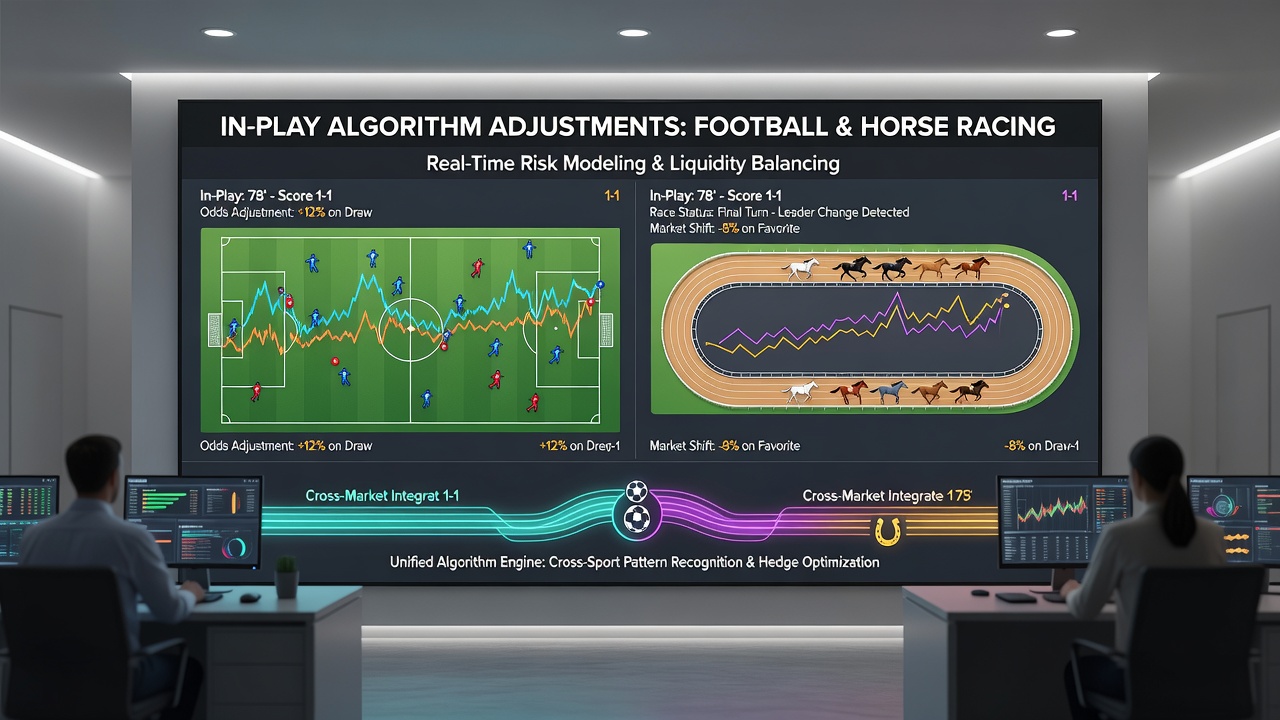
Football in-play markets typically widen or narrow spreads on total goals, next team to score, and Asian handicap lines once a red card occurs or a penalty is awarded, and the scale of each shift depends on remaining match time plus current score differential. Horse racing equivalents adjust place and win prices as runners enter the final furlong, with larger moves appearing when a long-shot makes an unexpected surge or when a favorite encounters traffic. These patterns emerge consistently across operators because the underlying statistical engines draw from overlapping data pools even though each firm maintains proprietary weighting schemes.
Research from the University of Nevada Reno's gaming analytics group has examined how latency thresholds affect the accuracy of these recalibrations across different sports. Data collected during the 2025-2026 season showed measurable differences in adjustment speed between turf and all-weather horse tracks, with the former requiring additional wind-speed variables that slowed certain model iterations by several hundred milliseconds. Similar studies conducted in Australian venues have highlighted the impact of camera angle coverage on football tracking precision, noting that venues with multi-angle systems produced tighter probability bands after set-piece events.
Risk Management Layers and Liquidity Controls
Bookmakers embed secondary risk engines that monitor exposure across correlated markets, and these layers automatically throttle stake acceptance or widen margins when liability on one outcome exceeds internal thresholds. In football, a sudden surge in bets on an underdog after an early goal can prompt the system to suspend related markets until fresh data stabilizes the models. Horse racing platforms apply analogous caps during races with large fields, where multiple runners remain mathematically live until the final stages. Such controls operate continuously, and they integrate with the primary pricing algorithms without requiring manual intervention from traders.
External regulatory bodies in several jurisdictions have begun requiring operators to log every algorithmic adjustment with timestamp and data source details, which creates audit trails that can later verify compliance with fair pricing standards. These requirements have prompted firms to enhance their logging infrastructure ahead of the August 2026 reporting cycle, when new data retention rules take effect in select markets outside the United Kingdom.
Conclusion
The interplay between real-time data ingestion, statistical modeling, and risk oversight produces the fluid odds environment that characterizes modern in-play betting on football and horse racing. Continued refinement of sensor technology and machine learning techniques suggests further compression of adjustment intervals, yet the fundamental requirement remains unchanged: each revision must rest on verifiable inputs and maintain internal consistency across all linked markets. Operators that balance speed with accuracy continue to refine these systems as data volumes grow and regulatory expectations evolve.