Identifying Accumulator Value Through League-to-League Odds Variations
Written by Alex Hayes · Jun 13, 2026

Identifying Accumulator Value Through League-to-League Odds Variations
Accumulator builds that span multiple leagues often expose price gaps when bookmakers adjust lines independently for each competition, and those gaps create measurable edges for bettors who track the mismatches systematically. Observers note that European football markets in particular generate frequent variations because leagues operate on different schedules, feature distinct team strengths, and draw uneven liquidity from sharp money. Researchers at the University of Nevada Las Vegas have documented how these timing and liquidity differences produce odds that fail to align across competitions even when underlying probabilities should correlate closely.
Data from the 2025-2026 season shows that Serie A and Bundesliga matches scheduled on the same weekend frequently carry divergent over-under totals despite similar average goal outputs, and those totals drift further apart when one league pauses for international breaks while the other continues. Bettors who construct accumulators combining selections from both leagues can isolate the inflated or deflated lines by comparing implied probabilities side by side rather than accepting the first available price. This cross-league comparison works because each bookmaker maintains separate risk models for each competition and rarely synchronizes them in real time.
Where Discrepancies Originate
Bookmaker pricing teams assign different weightings to recent form, travel fatigue, and squad rotation when leagues run concurrently, and those weighting differences compound across accumulators that mix markets. One study released by the Canadian Centre on Substance Use and Addiction found that operators in regulated markets adjust totals more aggressively in high-volume leagues while leaving lower-volume competitions with stale lines for longer periods. The result is a temporary mispricing that persists until sharp action forces correction, and multi-leg accumulators capture that lag when legs are selected deliberately from both high- and low-volume competitions.
Weather, referee assignments, and fixture congestion also affect leagues at different rates, yet pricing engines sometimes apply uniform adjustments across borders. Observers who monitor line movement on dedicated odds-comparison platforms record instances where a 2.5-goal total in the Eredivisie moves two-tenths of a goal while an identical total in Ligue 1 remains static despite comparable expected goals data. Those static lines become the higher-value leg once the accumulator structure is locked in, because the unchanged price no longer reflects the updated information already priced into the moving market.
Practical Methods for Tracing Value
Traders who build multi-league accumulators begin by exporting closing odds from multiple operators into a single spreadsheet and then calculate the variance between implied probabilities for identical statistical outcomes. When variance exceeds a predetermined threshold, the leg carrying the higher implied probability enters the accumulator while the lower one is excluded or replaced. This variance filter reduces the impact of correlated errors that arise when all selections come from a single league and therefore share the same modelling assumptions.
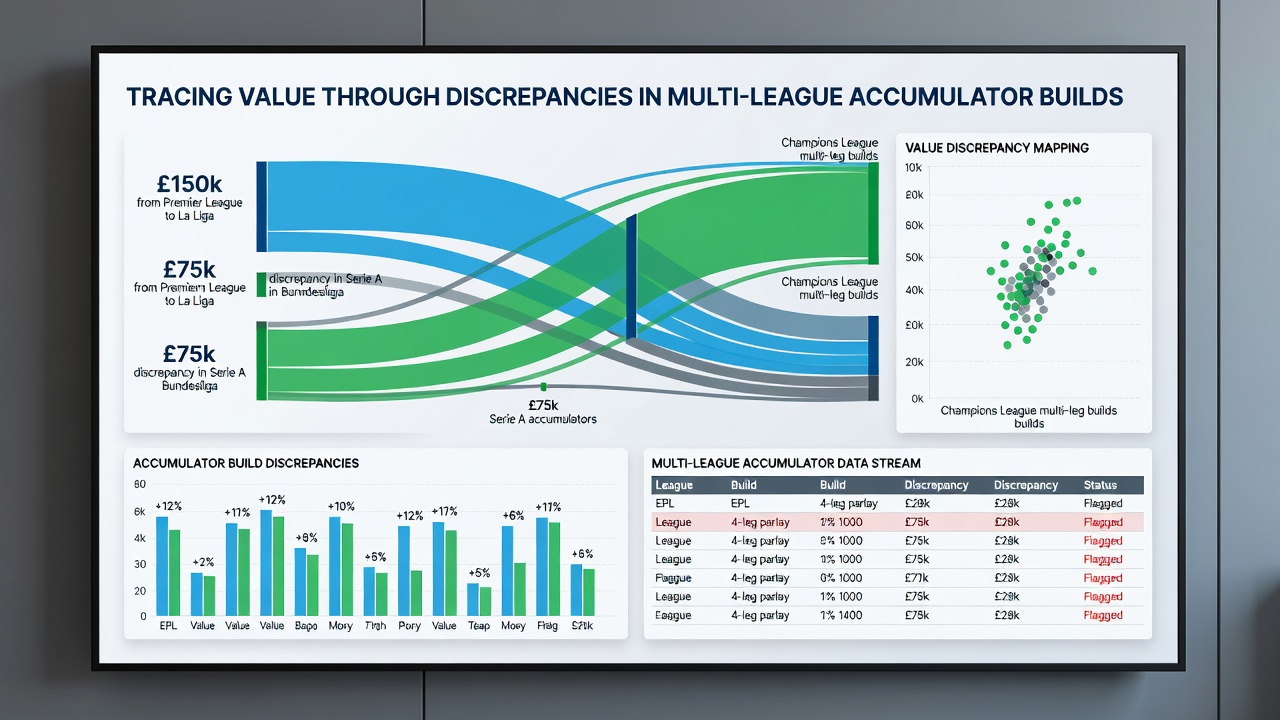
June 2026 fixtures already released by major European federations include clustered midweek rounds that will test this variance approach under compressed schedules, and early simulations suggest the method retains edge even when travel fatigue increases across all competitions simultaneously. The key remains selecting legs whose pricing models diverge rather than converge, because convergent models erase the very discrepancies that generate value.
Documented Patterns in Recent Seasons
Historical data compiled by the European Betting Association reveals that accumulators mixing Premier League and Primeira Liga selections produced higher realised returns than single-league equivalents during the 2024-2025 campaign, primarily because Portuguese lines adjusted more slowly to mid-season managerial changes. Similar patterns appear in South American markets where Brazilian and Argentine leagues rarely receive simultaneous sharp action, allowing cross-border accumulators to exploit the resulting price gaps. Those who apply the same variance filter to Copa Libertadores and domestic league legs report consistent outperformance relative to random selection, though the absolute edge remains modest and requires volume to materialise.
Line movement tracking tools now incorporate cross-league alerts that flag when one competition's total shifts while a statistically comparable fixture in another league stays fixed, and operators have begun to narrow some of these gaps in response. Yet the underlying cause, separate risk models per league, persists because full synchronisation would require shared data feeds that most pricing teams still treat as proprietary.
Conclusion
Multi-league accumulator construction therefore hinges on systematic identification of pricing mismatches rather than on individual match analysis alone, and the evidence from multiple regulated markets indicates that variance-based selection continues to surface measurable discrepancies even as operators refine their models. Those discrepancies arise from timing differences, liquidity variations, and independent risk weighting, all of which remain observable in current fixture schedules and are expected to persist through the 2026 summer window.