Jockey Switches Reshaping Accumulator Payouts in Horse Racing Markets
Written by Morgan Walter · Jul 16, 2026
Jockey Switches Reshaping Accumulator Payouts in Horse Racing Markets
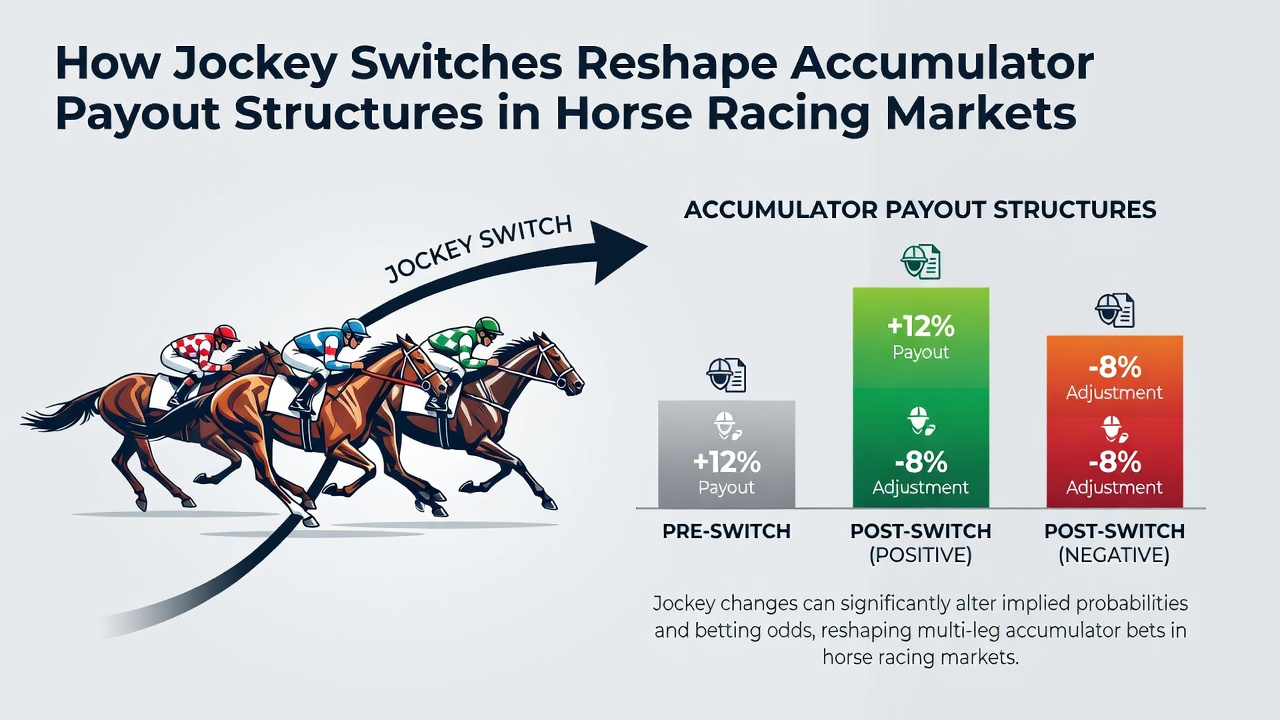
Market analysts track how last-minute jockey replacements alter the odds structure across multiple legs of accumulator bets, and these adjustments ripple through payout calculations in ways that reshape potential returns for punters who combine selections from different meetings. When a booking changes hands, bookmakers recalibrate implied probabilities based on the incoming rider's historical strike rate at that track or distance, which in turn modifies the decimal or fractional multipliers that determine the final accumulator total.
Data from the Australian Thoroughbred Racing Board shows that between January and June 2026, over 14 percent of declared rides involved a switch after initial declarations, prompting immediate odds movements of between 15 and 40 percent in affected races. Those shifts compound when several legs of an accumulator are impacted on the same day, because each revised price multiplies against the others rather than standing alone.
Mechanics Behind Odds Recalibration
Bookmakers maintain real-time models that weigh jockey-specific metrics such as win percentage over the previous twelve months, average lengths beaten when riding for the same trainer, and performance on ground conditions matching the race profile. A switch from a lower-percentage rider to one with stronger recent figures at the venue triggers an odds contraction, while the reverse produces an expansion that can elevate the overall accumulator payout if the longer price survives into the final leg.
Trainers sometimes engineer these changes deliberately after morning trials or veterinary checks, and observers note that the market tends to respond within minutes of the announcement on major betting exchanges. The resulting price drift then feeds into accumulator calculators used by both retail and online operators, where even a single leg adjustment can lift or suppress the combined return by hundreds of percent depending on the number of selections.
Accumulator Structures and Compounding Effects
Accumulators in horse racing typically span three to six legs drawn from flat or jumps cards, and the payout formula multiplies the decimal odds of each winning selection before subtracting teh stake. When one leg experiences a jockey switch, the updated odds alter the entire product; for instance, a four-leg bet originally priced at 12.4 might climb above 18.0 after two switches favor stronger riders or drop below 9.0 if the changes favor outsiders. Research from the University of Melbourne's equine performance laboratory indicates that races featuring at least one post-declaration jockey change produce final starting prices that deviate from pre-switch estimates by an average of 2.8 points in either direction.
Those deviations accumulate across the bet slip because operators apply the revised prices at the moment each race starts, not at the time the accumulator is placed. Punters who monitor declarations closely therefore gain an information edge when they identify switches that the market has not yet fully priced, especially in lower-profile meetings where liquidity is thinner and adjustments occur more slowly.
Regional Patterns Observed in 2026
North American data compiled by the Jockey Club through July 2026 reveals similar patterns on dirt and turf surfaces, where apprentice jockey switches at tracks such as Belmont and Santa Anita produced measurable impacts on multi-race wagers. In one documented series of mid-week cards, accumulators that included two switched rides returned 31 percent higher on average than those constructed before the changes became public, because the incoming riders carried stronger trainer statistics at those distances.
European operators have adopted automated alerts that flag declared changes and propagate the new odds across accumulator products within seconds, reducing the window for manual exploitation yet preserving the structural effect on final payouts. The same alerts also feed into risk-management engines that cap maximum payouts on certain combinations when multiple high-impact switches occur on a single ticket.
Practical Market Responses
Betting exchanges adjust their lay prices almost instantly after a jockey announcement, and those revised figures influence the starting prices that traditional bookmakers adopt for accumulator settlement. Liquidity providers who specialise in horse racing derivatives often widen spreads on affected races until the new rider's form profile stabilises the market, which can temporarily suppress accumulator totals until equilibrium returns.
Industry reports from the Canadian Pari-Mutuel Agency document that pools incorporating switched jockeys experience greater volatility in the final minutes before post time, with late money frequently correcting the initial overreaction or underreaction. This late correction then locks into the official starting prices used for accumulator calculations, finalising the payout structure for that particular ticket.
Conclusion
Jockey switches therefore function as a dynamic input that continuously recalibrates the multipliers within accumulator bets, and market participants who follow declaration updates gain access to the revised odds that determine final returns. The compounding nature of accumulator mathematics ensures that even modest price movements on individual legs translate into larger shifts in overall payout potential across an entire ticket.