Referee Assignment Patterns Shape Outcomes in Football's Live Totals Markets
Written by Klara Hoffmann · Jun 22, 2026

Referee Assignment Patterns Shape Outcomes in Football's Live Totals Markets
Referee assignments in professional football follow structured rotation systems across major leagues, and these patterns create measurable effects on in-play totals markets that cover goals, cards, and corners. Data compiled from European and South American competitions shows consistent variations in foul rates, card issuance, and added time depending on which officials receive specific fixtures, while observers note that these differences become most apparent once matches move into live betting windows.
League Rotation Systems and Selection Criteria
Football governing bodies assign referees through centralized panels that balance experience levels, travel distances, and recent performance metrics, yet patterns emerge when analysts track individual officials across multiple seasons. UEFA and CONMEBOL maintain databases that log every appointment, and these records reveal that certain referees handle a higher proportion of high-stakes matches while others receive more midweek fixtures with lower expected goal outputs. Researchers who examined five seasons of Serie A and Bundesliga data found that officials with stricter disciplinary histories receive assignments in games involving teams that average more than 14 fouls per match, creating a feedback loop that influences both pre-match lines and in-play adjustments.
Statistical Tendencies Across Competitions
Figures released by Opta reveal that referees in the Portuguese Primeira Liga issue cards at rates ranging from 3.8 to 5.6 per game depending on the assigned crew, while similar spreads appear in the Brazilian Série A where stoppage time averages fluctuate by nearly two minutes based on the official's profile. These variations matter because in-play totals markets update continuously, and bettors monitoring card and corner counts adjust stakes when an official known for quick bookings enters the field after halftime. One study published in the Journal of Quantitative Analysis in Sports tracked over 2,400 matches and confirmed that referee-specific foul differentials persist even after controlling for team styles and scorelines.
June 2026 marks the start of new rotation cycles in several domestic leagues following the conclusion of international tournaments, and early fixtures already show shifts in assignment frequency for officials returning from national team duty. Market makers at major betting operators have incorporated referee identifiers into their models, allowing odds to move within seconds of an official's name appearing on pre-match sheets.
In-Play Market Reactions to On-Field Decisions
Live totals on cards and corners respond directly to referee behavior because each decision alters the expected number of future stoppages. When an official with a documented tendency toward advantage play takes charge, corner markets often drift lower in the first half since fewer free kicks convert into set pieces. Conversely, referees who stop play frequently generate spikes in card totals once the match reaches the 60-minute mark, and traders who monitor these patterns report tighter spreads on over lines for bookings in those specific games.
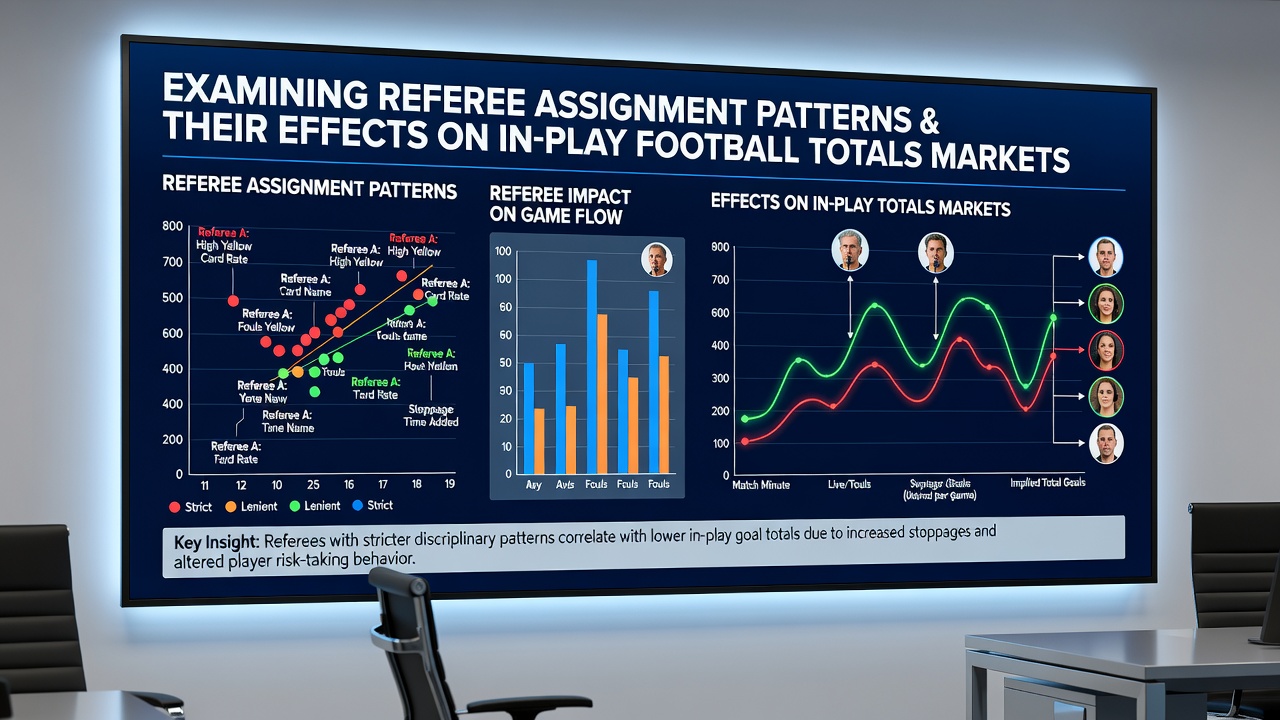
Academic work from the University of Sydney's sports analytics group examined referee effects on goal totals and found smaller but detectable influences through added time allocation, with some officials consistently extending matches by 30 to 90 seconds beyond the average when games remain close. These extra minutes increase the probability of late goals, which in turn moves in-play over/under lines on total goals even when scorelines appear settled. Australian researchers cross-referenced their findings with data from the A-League, where referee assignments rotate more rapidly than in larger European leagues, producing clearer statistical signals for totals traders.
Geographic and Cultural Variations in Officiating
Referee training programs differ across confederations, and these differences translate into distinct market impacts when officials cross borders for continental competitions. South American referees working in Copa Libertadores matches issue cards at higher baseline rates than their European counterparts, according to reports from the South American Football Confederation, while North American officials in CONCACAF tournaments show greater tolerance for physical challenges that reduces corner volume. Bettors active in multiple regions have learned to adjust their in-play strategies when league-specific referee pools give way to mixed crews during international windows.
Industry reports from the European Club Association highlight how clubs track referee statistics internally to prepare set-piece routines, yet these same datasets now feed into third-party models used by betting platforms. The result appears in narrower margins on live totals once referee identities become public, because market efficiency improves when historical tendencies receive wider circulation.
Conclusion
Referee assignment patterns generate predictable shifts in foul, card, and stoppage distributions that directly influence in-play football totals markets. Comprehensive datasets from multiple confederations demonstrate that these effects remain measurable after statistical controls, and operators continue to refine their pricing algorithms around official rotations. As leagues enter new cycles in June 2026, ongoing monitoring of assignment trends will likely sustain the connection between referee profiles and live market movements across goal, card, and corner totals.